Friday, 11 February 2011

My Reflective Statement..


This unit taught me how to research, document, and express my thoughts and ideas in a more explicit and obvious way, through textual and visual details.
To my surprise, I have actually enjoyed creating my blog.
For the rough guide as well as the other study tasks and work, I used appropriate material to define and illustrate my ideas and interpretations in the most coherent way. Visual information is an important component of my work as it is a powerful approach to communicate my ideas to the viewers.

Looking at other blogs while working on mine, I realized that I quickly lost interest in the ones that had heavy written material. The projects presented to us, and the research we had to present gave me a great amount of knowledge.  My blog presentation is simple and clear. I tried to get my idea across in the most distinct and direct way. I have given my opinion, but also looked at other opinions in magazines and online articles. I have been following two blogs that have inspired me in creating my own: www.thesartorialist.com and www.garancedore.fr.
They both have great photographic content accompanied of short and straightforward descriptions.

Looking back at my work, I now realize I could have talked a bit more about personal experiences, exhibitions, and interesting information about art and design. 

Tuesday, 8 February 2011

The Museum of Brands


Barbican - Future Beauty: 30 Years of Japanese Fashion


Pictures taken from    http://worldmanabouttown.com/2010/10/27/future-beauty-30-years-of-japanese-fashion/

Aware: Art, Fashion, Identity

  Imponderabilia Performance, 1977 - Marina Abramovic - Performance - Re-performed continuously in shifts -

Yojhi Yamamoto Femme collection Autumn/Winter 1991-92

'Son' of Sunzai Suru, 2010 - Hussein Chalayan -Installation shot from GSK Contemporary - Aware: Art Fashion Identity, Royal Academy - 


Pictures taken from http://www.anothermag.com/current/gallery.aspx?id=659&image=21362&modal=false

Monday, 7 February 2011

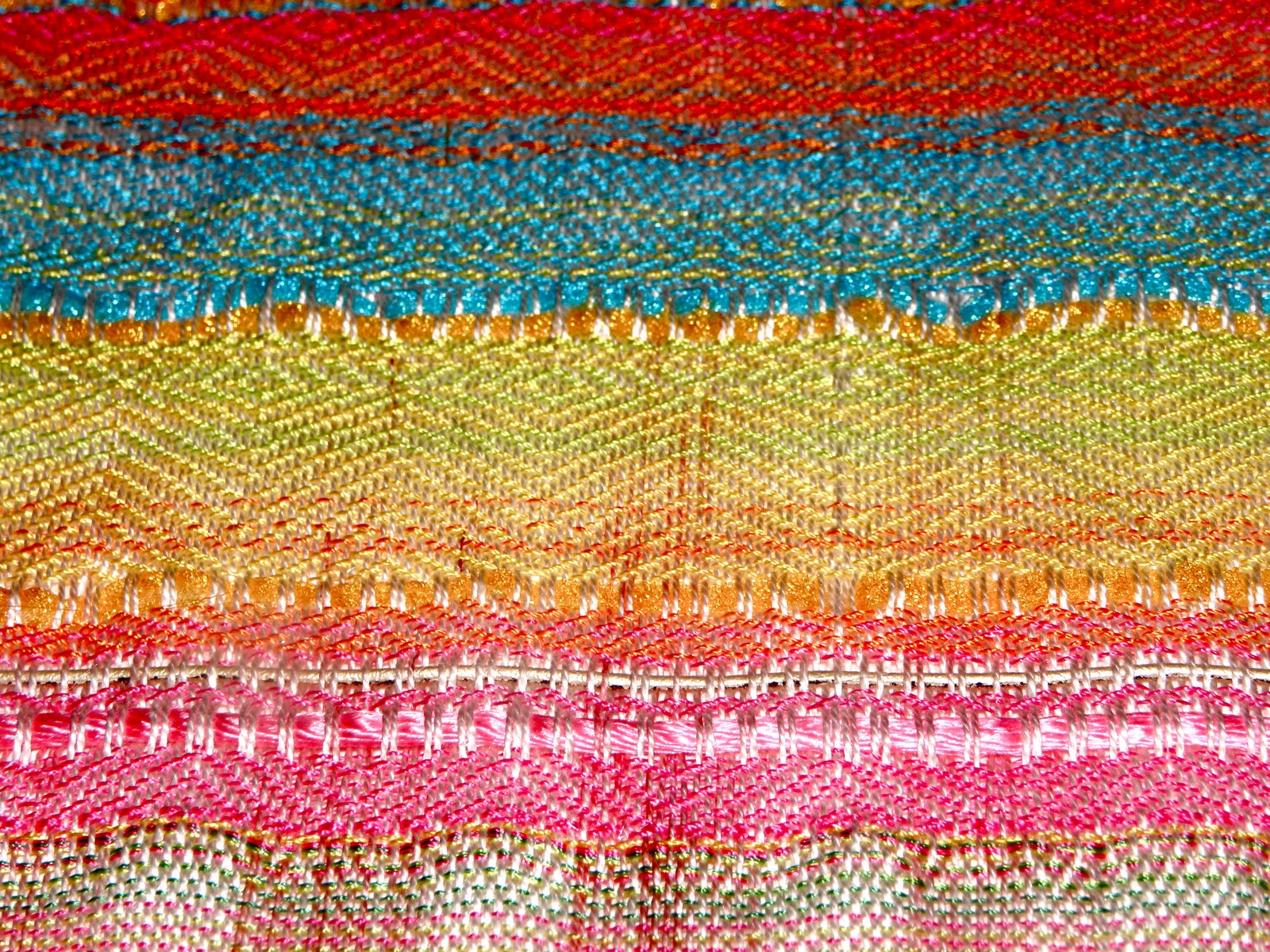
Weave ...


During those two weeks, I mainly worked and created my samples with viscose, exploring different ways it could be used. I combined it with cotton, silk and steel, and different kind of ribbons and thread.
The designs full of colors, yet simple, are all linked. I probably could have played around a bit more with it- experimenting with different yarns, weights, and other materials- but I think I handled myself.


Print ...


Even though I used to know how to use Photoshop, this first week in print made me discover different tools and pattern techniques that I did know nothing about.
This block taught me how to print, how to dye, the different techniques-for example devore- as well as the colored, white, and illuminating discharges.
I tried to explore my collection and drawings as much as possible through the colors and their combination making them look playful and “candied”.


Wednesday, 8 December 2010

Pop-Up 2 : 3D Creation


For our second pop-up project, I decided to use all different kinds of candy, marshmallows… as my objects.
Before our photography induction, we were asked to create 3d objects inspired by our original collections. Trying to interpret my theme around childhood and candy, on the basis of textures, materials, colors, and form, I used tissue paper around ping-pong balls, and stuck them together with varnish to give them a shinier finish.
I think that the creation, as well as the pictures looked much more interesting then the original collection, and that is why I replaced it and explored my creation for the upcoming blocks.

Tuesday, 7 December 2010

Trade Between East and West : Indian Textiles

Dress piece - Madras (chennai), india 1882 / Silver, silk, spangles & beetle wings 

Kincob - Benares (varanasi), India 1850 / silk

Kincob - Benares (varanasi), India 1850 / silk


Sari - Benares (varanasi), India 1850 / silk

Blouse piece - Bombay (Mumbai), India - Early 19th century / Embroidered Satin


Indian textiles have a long and prestigious history. Unlike in Europe during the 18th century, Indians had very fine cotton- lighter and softer then the European linen – printed cotton ‘chintz’ (spotted) with bright colors that could be washed, woven cashmere, and unique patterns.

As we could see at the exhibition, they were often inspired by nature. Many of their patterns featured trees, animals, birds, marine creatures, and their patterns were based on flowers and leaves. But they also had great techniques, for example, mordant dyeing which gives the fabric an intense color not to fade.

Europeans were very interested in those fabrics. They traded them in Asia- for spices, coffee, and tea- and in Africa- for gold and ivory-
They were luxurious good, as well as washable substitutes for other European textiles.

India had great merchandise, but still tried to adapt their goods according to every market. For example, they created textiles based on French poetry for the French market. In 1800 they remodeled to the neoclassical style, and exported muslin and Kashmir shawls that were produced into neoclassical clothing and interiors.

“India was to become the greater exporter of textiles the world had ever known.”

However, after the 1770, Britain overtook India as a major exporter of printed cotton cloth, and was not just self-sufficient, but also exported to India.


picture taken from http://www.vam.ac.uk/collections/asia/asia_features/indian_textiles/objects/index.php

Monday, 6 December 2010

DIAGHILEV and the Golden Age of the Ballets Russes


Picasso stage curtain - picture taken from theguardian.co.uk

Diaghilev was known to be a dictator, a charmer, and a charlatan. Nonetheless, he was a genius.
 Diaghilev changed the whole idea of ballet, by originating thoroughly new ones instead of repeating the previous ones. His dazzling, unusual, and glamorous designs and colors used ever since his first ballets (1909-14) initiated a new artistic breakthrough in the 20th century.

Even though he was best known for his music, Diaghilev transformed the theatre, the fashion, as well as the daily life through ballets- by creating a spectacle as whole instead of looking at it in separate parts.

We can see through the exhibition the development of his designs, as well as his collaboration with other avant-gardist designers, as Matisse, Braque, and Coco Chanel for the costumes, amongst many others.

However it is the 10 foot tall stage curtain with high cubism characters, created by Picasso- during his collaboration with Cocteau and Diaghilev in 1917 - exhibited at the V&A that impressed me the most.

Sunday, 5 December 2010

African Gallery - British Museums


Tree of Life - Made by Kester, Hilario Nhatugueja, Fiel dos Santos and Adelino Serafim Mate Maputo, Mozambique, 2004 
(Taken from  http://www.britishmuseum.org/explore/highlights/highlight_objects/aoa/t/tree_of_life.aspx)


In this whole exhibition it is those two pictures that intrigued me the most. This African modern art took a political turn in these photographs. At first, it was unclear what the ‘tree of life’ was made of. But, when discovered, the perception and the message given changes completely.
This project encourages people to trade their weapons for useful tools such as bicycles, and sewing machines…


Saturday, 4 December 2010

Science Museum -

Trash Fashion: Designing Out of Waste

Nowadays, ‘we’re buying a third more clothing then we did a decade ago’. The tailoring methods as well as the chemicals used and many other factors affect today’s environment. In this exhibition, designers are trying to promote the creation of clothing without waste by exploring the latest approaches and techniques.

New dyeing technologies (no use of water at all), tricks of light (material: morphotex -instead of dyeing), different tailoring methods, and biocouture, are some of the numerous techniques displayed.

This exhibition not only made me realize the damages even fashion has on the environment, but also enlightened me about the technologies discovered and developed during the past years to reduce the negative impacts on the environment.


Easier Recycling

The use of just one type of fiber makes any fabric much easier to recycle.
Kate Goldsworthy experiments here on a 100% polyester fabric using harmless chemicals and laser beams to cut into the fabric and create a pattern.


Sugar-made plastics

Polyester clothing is made out of oil, which is a non-renewable resource that is running out. ‘Ingeo’ –a bio-plastic called polylactic acid, produced by plant sugar- corn, wheat, sugar cane…- instead of oil.
Unlike oil, plant sources are renewable, and can be produced really quickly giving it a great advantage for the environment.


Bio-Couture

‘Cotton is the thirstiest fabric on the planet – 210,000 billion liters of water is used in its production each year.which harms the environment as well as the human’s health.
This is why Susanne Lee, a researcher at Central Saint Martins, started designing the bio-couture line of clothing. This concept consists of creating cellulose out of tiny bacteria grown in bathtubs of sweet green tea.
Although this technique appears to be a perfect option, it is still not in use.  The material absorbs water and can break down really easily.


Challenge of Materials

Tantalum

 Tantalum was originally used as lamp filaments. However, taking into account its benefits and assets, it became an important metal. Tantalum has a high melting point, and is easy to work. It has many uses as implants left in the body for surgery, s special glass for camera lenses, and occasionally used in precious watches. 

Stitch ...


In my opinion, stitch give you a big opportunity to explore your creative side, develop your artsy instinct and imagination, explore a huge number of techniques and materials to be able to achieve in the end the perfect outcome you were looking for.

Stitch made me discover and explore new techniques and manipulation of materials and fabrics that I wasn’t aware of.
However, during the two weeks of stitch I got sick and couldn’t research and explore as much as I would normally have. I could have been more creative, and come up with different ideas to translate my objects and drawings.
Still, I was happy about the outcome I came up with, and enjoyed working in 2D as well as in 3D.   


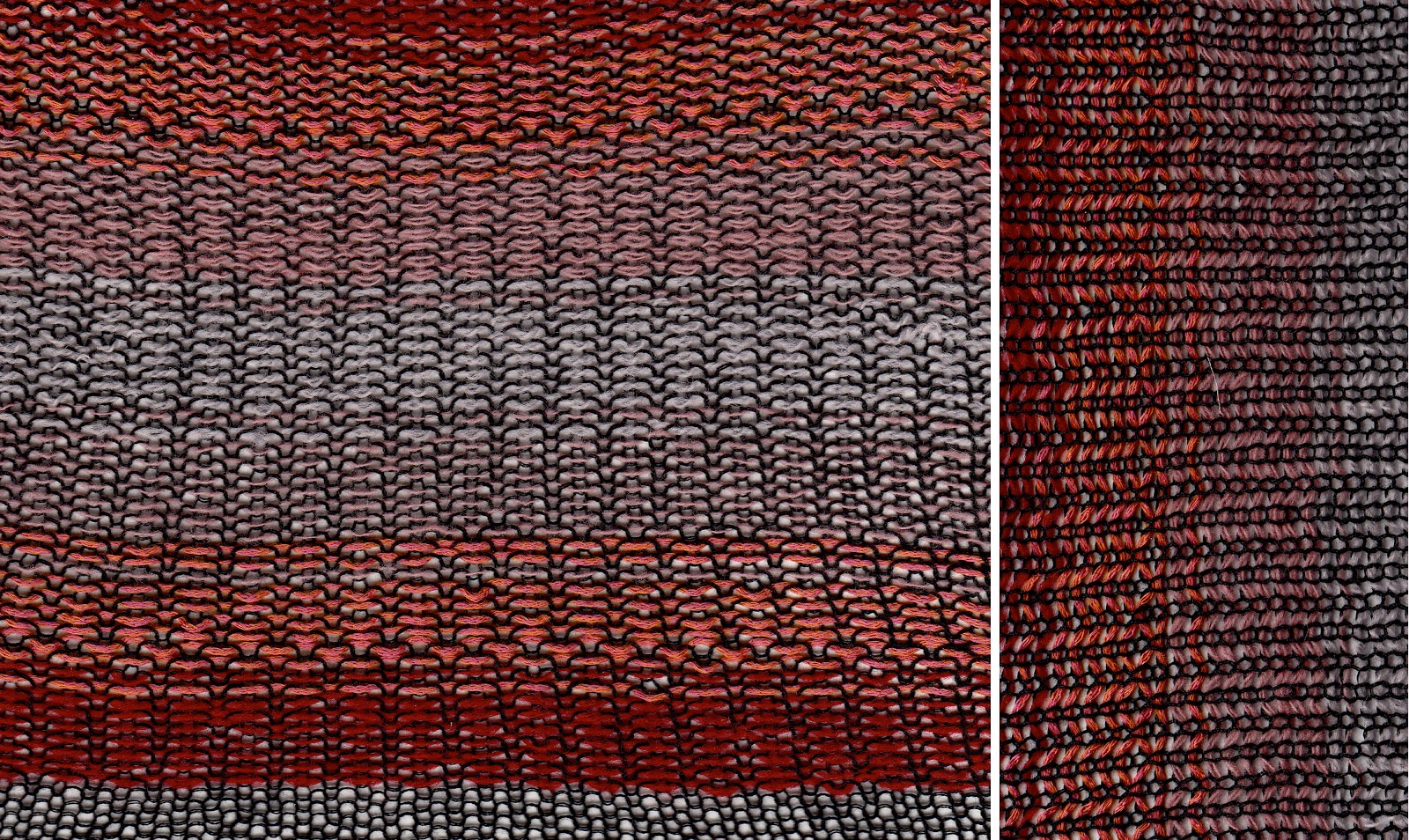
Knit ...


Knitting gives superb outcomes if properly done.
I personally couldn’t keep up with the many techniques given to us during a weeklong.

Since I struggled a bit in the beginning, I remained in my comfort zone, and stuck to the weaving within knitting technique.

However, I regret not experimenting and exploring other techniques- ladders, shapes-, textures, weights …  and since I would have loved to know how to really manipulate the knitting machines, if I get another opportunity, I would certainly try to make the most it


Pop-Up 1

\